




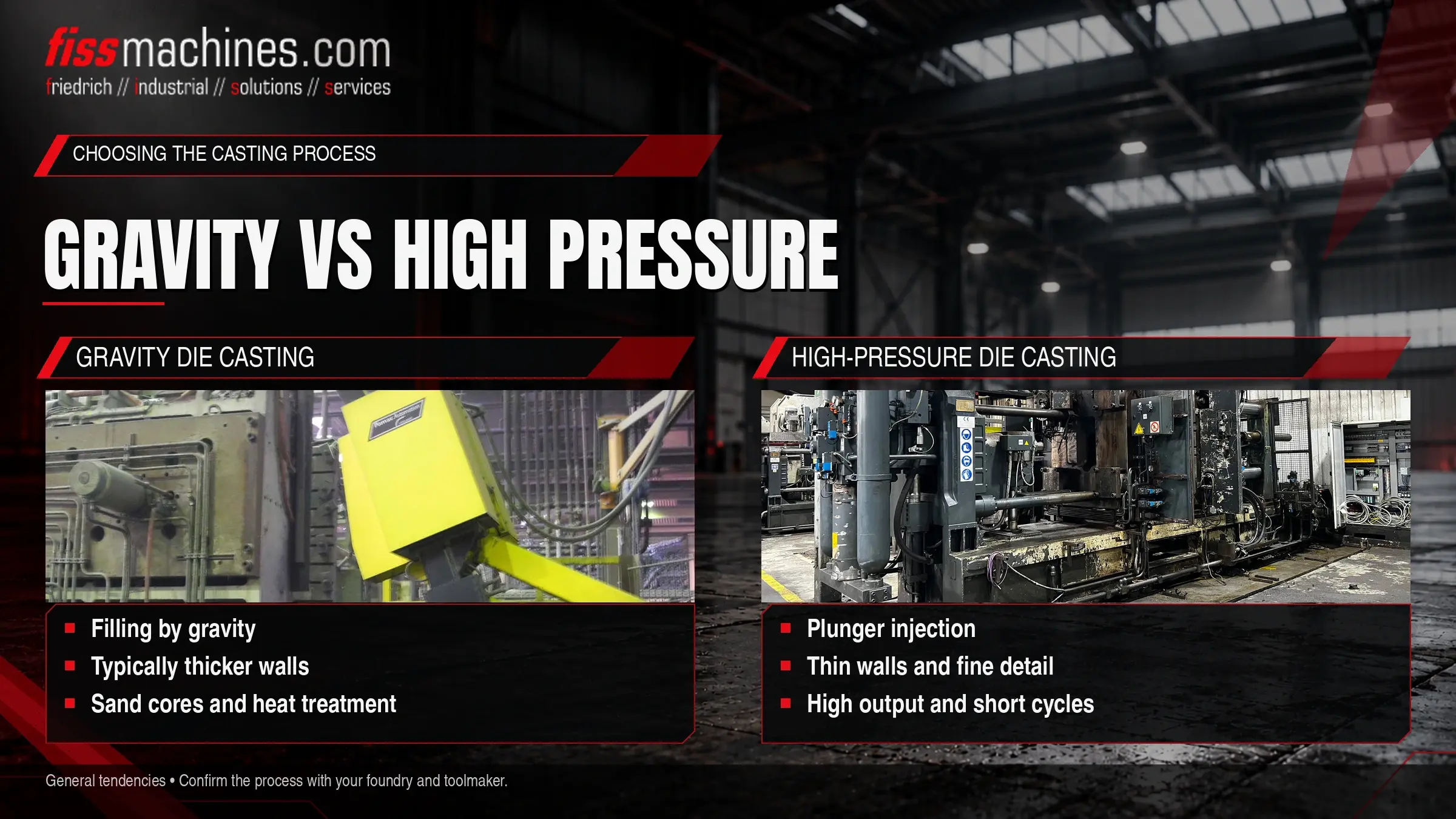
Gravity Die Casting or High-Pressure Die Casting? Choosing the Right Process
Both processes pour metal into a reusable metal die, and both are called die casting. That is where the similarity ends. In gravity die casting, the metal flows into the die under its own weight; in high-pressure die casting, a plunger injects it at high speed and pressure. The choice between them shapes part design, tooling investment, achievable quality and the type of machine you need. This article compares the two and explains when each one makes sense.
What Is the Main Difference?
Gravity die casting (also called permanent mould casting) fills a coated metal die by pouring, often with tilting to control the flow. Filling is slow, walls are typically thicker, sand cores can be used and castings are generally suitable for heat treatment. High-pressure die casting injects metal within a very short time, allowing thin walls, fine detail and short cycles, but requires larger machines and more expensive dies.
Gravity die casting is not sand casting: the die is permanent and reused for many castings, while a sand mould is destroyed after each pour.
Sorting Out the Terms
Casting terminology varies between regions, which causes confusion in enquiries and quotations. In British usage, "die casting" without a qualifier usually means high-pressure die casting, и "gravity die casting" means permanent mould casting by gravity. In North America, the same gravity process is usually called "permanent mold casting". In German, it is "Kokillenguss".
| Process | Mould | How the metal enters |
|---|---|---|
| Sand casting | Expendable sand mould, destroyed after each casting | Poured, gravity |
| Gravity die casting | Permanent metal die, optionally with sand cores | Poured, gravity, often with tilting |
| High-pressure die casting | Permanent steel die with slides and ejectors | Injected by plunger at high speed and pressure |
Low-pressure die casting sits between them: it also uses a permanent die, but fills it from below with gas pressure. It is a separate process with its own machines and is not covered in detail here.
How Gravity Die Casting Works
The die is preheated and coated with a refractory die coating. The coating insulates the metal from the die surface, influences how fast the metal cools and helps release the casting. Molten metal is poured into a pouring cup and flows through runners and risers into the cavity. On tilting machines, the die rotates during pouring so that the metal enters more calmly and with less turbulence. After solidification the die opens and the casting is removed; any sand cores are knocked out afterwards.
Machines and equipment
Gravity die casting can be done with manually operated dies, but production is usually carried out on gravity casting machines that open and close the die halves, move cores and, in tilting versions, rotate the die. Machines are comparatively light because there is no high metal pressure to resist. Pouring can be manual or automated, for example with a robot ladle.
Typical parts
Cylinder heads, manifolds, pump and valve bodies, chassis parts and fittings are typical examples. Aluminium alloys dominate, but copper alloys such as brass are also cast in permanent dies, for example for sanitary fittings.
How High-Pressure Die Casting Differs
In HPDC, metal is forced into the die by a hydraulically driven plunger, either from a cold shot sleeve or from a hot chamber gooseneck. The die is held closed by a clamping unit dimensioned for the high metal pressure, which is why HPDC machines are much heavier. The die is sprayed with a release agent rather than coated with a refractory layer. The differences between cold chamber and hot chamber machines are explained in Cold Chamber or Hot Chamber?, and the filling physics in Mold Filling and Vacuum.
Gravity Die Casting and HPDC Side by Side
| Критерий | Гравитационное литье под давлением | Литье под высоким давлением |
|---|---|---|
| Заполнение | Гравитационное, медленное, может быть наклонено | Гиперпоршневой впрыск за очень короткое время |
| Толщина стенки | Обычно более толстые стенки | Толстые стены и возможны мелкие детали |
| Коротные вставки | Металлические и песчаные корни, возможны сложные полости | Металлические корки и слайды; уступы ограничены |
| Поверхностная обработка литейной поверхности | Облицовка огнеупорным покрытием литейной формой | Средство разделения распыляется каждый цикл |
| Т heat treatment | Обычно возможно | Ограничено для обычных деталей |
| Поверхность и допуски | Хорошие, текстура покрытия может проявляться | Очень хорошая поверхность, близкие допуски |
| Цикл времени | Сравнительно длинный | Короткий |
| Инвестиции в машины и пресс-форму | Ниже | Выше |
| Экономические партии | Малые и средние серии | Средние и очень большие серии |
Какой процесс подходит вашей детали?
Гравитационное литье чаще подходит когда
- Стены средние или толстые и секции варьируют
- Внутренние каналы требуют песчаные корни
- Деталь должна быть термически обработана или сварена
- Годовые объемы не обоснованы к HPDC-форме
- Требуются медьевые сплавы
HPDC чаще подходит когда
- Стены тонкие и поверхности крупные
- Нужны высокие мощности и короткие циклы
- Поздовательность допусков снижает обработку
- Планируются цинковые или магниевые сплавы
- Термическая обработка не требуется, или применяются особые технологические маршруты
Это тенденции, а не правила. Переработка дизайна может перевести деталь из одного процесса в другой, например, за счет изменения толщины стенки или замены песчаного корня с помощью слайда. Ранняя дискуссия между конструктором, литейной и инструментальщиком обычно окупается.
Часто задаваемые вопросы
Является ли гравитационное литье тем же, что песчаное литье?
Нет. Оба основаны на гравитации, но песчаное литье использует расходную песчаную форму, в то время как гравитационное литье — постоянную металлическую форму. Песчаные корни могут использоваться в гравитационных формах, что иногда вызывает путаницу.
Можно ли использовать HPDC-машину для гравитационного литья?
Нет. Процессы требуют разного оборудования: машины для гравитационного литья обрабатывают форму и tilting, в то время как HPDC-машины сконструированы вокруг конца вылива и тяжелого зажима.
Почему гравитационное литье часто выбирают для меди?
Медные сплавы имеют высокие температуры плавления, что требует повышенной прочности компонентов выстрела HPDC и пресс-форм. Гравитационное литье в постоянных формулах — устоявшийся путь для многих медных деталей.
FISS предлагает бывшие в употреблении машины для обоих процессов.
Независимо от того, указывает ли ваша деталь на гравитационное литье или HPDC, FISS поможет оценить подходящие бывшие в употреблении машины и вопросы, которые стоит уточнить перед покупкой.
