




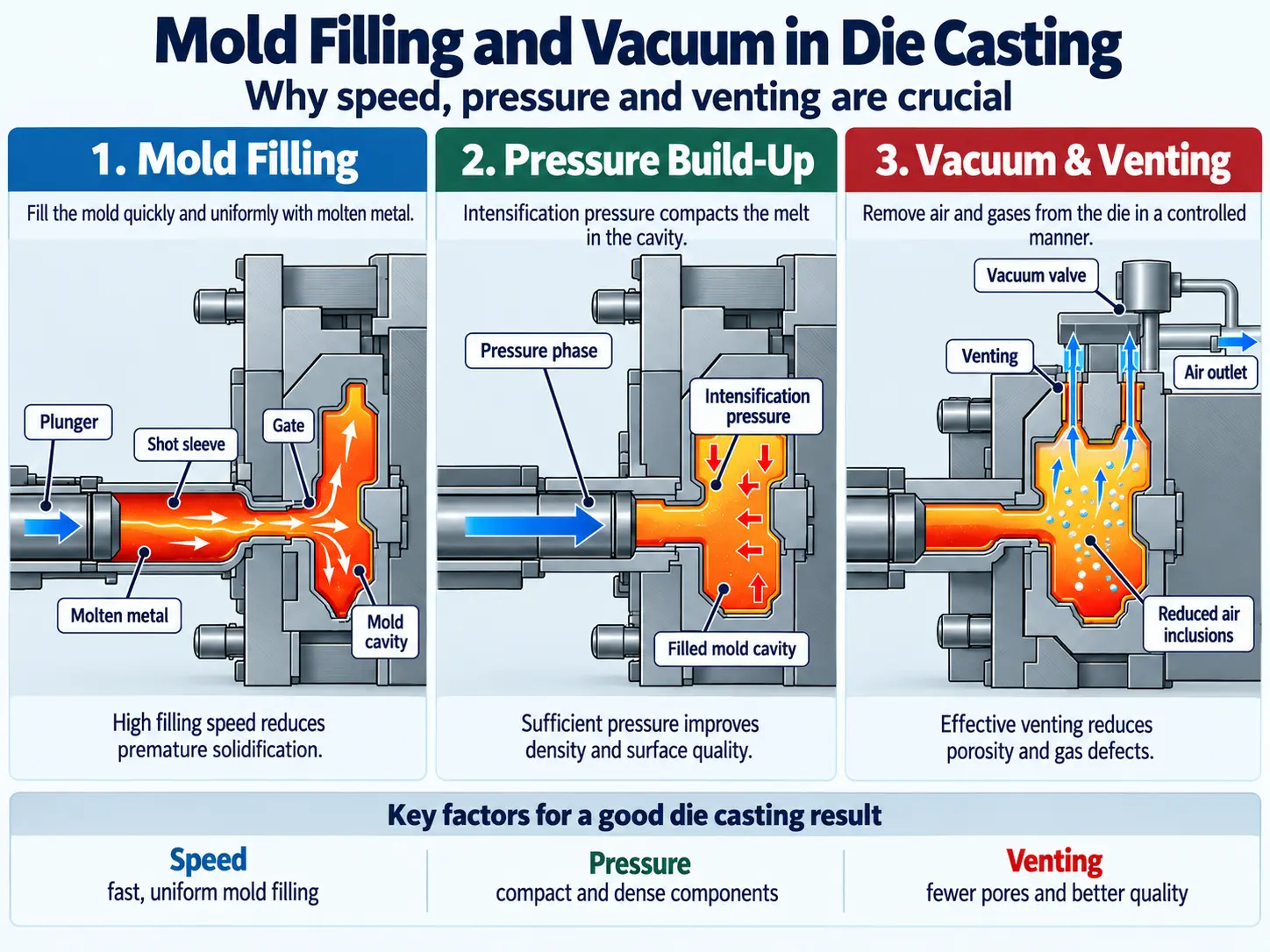
Mold Filling and Vacuum in Die Casting: Why Speed, Pressure and Venting Matter
Mold filling is one of the decisive stages of the die casting process. The molten metal must reach all areas of the die cavity before excessive solidification occurs, while air and process gases must be able to escape in a controlled manner. Shot speed, gating design, pressure build-up, venting and vacuum therefore have a direct influence on casting quality and process reliability.
Why Are Mold Filling and Vacuum Important in Die Casting?
During mold filling, molten metal is accelerated through the gating system and into the die cavity. The objective is to fill the cavity completely before the metal solidifies too far, without creating unnecessary turbulence, air entrapment or excessive impact on the die.
Vacuum-assisted die casting supports this process by removing air and gases from the shot system and die cavity before and during filling. This can reduce gas-related porosity and is particularly valuable when high requirements are placed on density, mechanical properties, weldability or subsequent processing.
What Happens During Mold Filling?
The casting phase begins before molten metal actually enters the die cavity. In a cold chamber machine, the metal is first dosed into the shot chamber. The plunger initially moves forward in a controlled manner so that the molten metal is transported toward the gate without creating excessive waves or trapping unnecessary air.
The machine then switches to the faster filling phase. The plunger accelerates and forces the molten metal through the runner and gate system into the cavity. Once the cavity is filled, the plunger decelerates rapidly and pressure is applied to the metal during the early stage of solidification.

The Filling Process Is More Than One Fast Plunger Movement
A stable die casting process requires the individual phases of the shot profile to work together. The exact values depend on the alloy, machine, die and component, but the functional sequence can be divided into several important stages.
Metal Dosing
In cold chamber die casting, the required quantity of molten metal is introduced into the shot chamber. Consistent dosing is an important basis for a repeatable shot process.
Controlled Plunger Advance
The plunger moves the molten metal toward the gate. The movement should avoid excessive wave formation, turbulence and unnecessary air entrapment inside the shot chamber.
Fast Mold Filling
The plunger accelerates and the molten metal passes through the gate into the die cavity. The required filling speed must allow the cavity to be filled before premature solidification occurs.
Pressure Build-Up and Intensification
After the cavity has been filled, the plunger movement stops and pressure is transferred into the molten metal. As long as a liquid metal connection remains available, pressure can contribute to densification during solidification.
Solidification and Part Removal
Once the casting has solidified sufficiently, the die opens and the component can be ejected and removed from the machine.
Faster Is Not Automatically Better
One of the central tasks in process setup is determining a suitable mold-filling time. The molten metal must remain sufficiently fluid to reach thin walls and distant areas of the cavity, but simply increasing the velocity does not automatically improve casting quality.
| Filling Condition | Possible Effect | Typical Risk |
|---|---|---|
| Too slow | The molten metal loses temperature and begins to solidify before the cavity is completely filled. | Incomplete filling, cold shuts, flow marks and reduced surface quality. |
| Process-appropriate | The cavity is filled within the required time with a controlled flow pattern. | Stable filling requires the shot profile, gating system and die temperature to be matched to the component. |
| Too fast | The metal enters the cavity with unnecessarily high kinetic energy and stronger turbulence. | Increased air entrapment, die erosion, soldering, flash or high dynamic pressure peaks. |
Why Pressure After Mold Filling Matters
Pressure in the die cavity does not remain constant throughout the shot. When molten metal reaches the gate and begins to enter the cavity, dynamic pressure develops. During filling, the pressure changes as the molten metal flows through different sections of the component.
Once mold filling is complete and the plunger stops, a higher static pressure can be transferred through the liquid metal. This pressure can support densification of areas that are still liquid or partially solidifying.
However, this pressure transfer only works while a continuous liquid metal path remains between the plunger and the relevant area of the casting. When a thin section such as the gate solidifies, further pressure can no longer be effectively transferred into the cavity.
Where Does the Air in a Die Casting Die Come From?
Before the molten metal enters, the runner system and die cavity contain air. In cold chamber die casting, additional air may also be present in the shot chamber. During the process, gases can also be generated from release agents and lubricants.
Because die casting cavities are filled within a very short period, this air must escape rapidly. If the gas cannot leave the cavity before it is surrounded by molten metal, it can become trapped inside the casting and contribute to gas porosity.
Overflows can be positioned near areas that fill last so that air, gases and the first metal front can move out of the functional casting area.
Narrow channels at the parting line provide a controlled route for air to escape from the die cavity.
Chill vents can provide a relatively large venting cross-section while rapidly cooling the metal that reaches the venting area.
A vacuum system actively removes air from the die cavity and, depending on the system design, from the shot chamber.
What Does Vacuum Do in the Die Casting Process?
In vacuum-assisted die casting, the air inside the casting system is actively evacuated before and during the filling process. Depending on the system design, the vacuum can act directly on the die cavity or can also include the shot chamber.
The objective is simple: reduce the amount of gas that can become trapped by the rapidly advancing molten metal. A lower gas content can improve internal casting quality and is particularly relevant for components with demanding requirements for mechanical properties, leak tightness or subsequent processing.
For the vacuum system to work effectively, the die, shot system, connections and seals must provide sufficient tightness. A powerful vacuum pump alone cannot compensate for major leakage in the system.
When Does Vacuum Become Particularly Relevant?
Conventional venting can be sufficient for many die casting applications. Vacuum becomes increasingly relevant as the requirements placed on the casting rise.
| Requirement | Why Venting Matters | Potential Role of Vacuum |
|---|---|---|
| Low gas porosity | Trapped air can remain inside the casting as gas pores. | Active evacuation reduces the amount of air available for entrapment. |
| Leak-tight components | Internal pores can create leakage paths depending on their position and connectivity. | Reduced gas porosity can support production of demanding pressure-tight components. |
| High mechanical demands | Gas pores reduce the effective load-bearing cross-section and can negatively influence mechanical properties. | More controlled evacuation can contribute to more consistent internal quality. |
| Welding or heat treatment | Entrapped gas can expand significantly when the component is exposed to elevated temperatures. | Low-gas casting processes can improve the conditions for subsequent processing when the complete process is designed accordingly. |
Which Parameters Must Be Considered Together?
Mold filling is the result of several interacting parameters. Optimizing only one of them rarely produces a stable process.
- alloy and molten metal temperature
- die temperature and temperature distribution
- quantity of molten metal and dosing repeatability
- slow-shot plunger speed
- switching point between slow and fast shot
- fast-shot plunger speed
- gate position and gate cross-section
- runner and overflow design
- venting channels and chill vents
- vacuum timing and available evacuation capacity
- pressure build-up and intensification pressure
- condition and sealing of the shot unit and die
- release-agent application and residual moisture
- repeatability of machine control and process monitoring
Typical Signs That the Filling Process Should Be Investigated
Casting defects cannot be assigned to one process parameter solely from their appearance. Nevertheless, recurring defects can indicate that the filling and venting concept should be examined systematically.
Incomplete Filling or Cold-Shut Areas
Check filling time, metal and die temperature, gate design and whether the molten metal reaches critical regions before excessive solidification occurs.
Recurring Gas Porosity
Examine the slow-shot phase, turbulence, venting paths, vacuum performance, release-agent application and possible leakage in the vacuum system.
Flash or Strong Pressure Peaks
Excessive filling velocity, an unsuitable switching point, insufficient clamping conditions or an unfavourable flow pattern may contribute to high dynamic loads.
Unstable Quality from Shot to Shot
Check whether dosing, shot profile, die temperature, vacuum timing and pressure build-up are repeatable from cycle to cycle.
Why Mold Filling Also Matters When Selecting a Used Machine
When evaluating a used die casting machine, clamping force is only one part of the technical assessment. The shot unit and its control system must also be capable of producing the shot profile required by the intended component.
Depending on the production task, it can therefore be important to check how accurately the machine controls plunger movement, switching points, pressure build-up and process monitoring. If vacuum-assisted production is planned, suitable interfaces and integration into the complete cell must also be considered.
- condition of the shot unit and plunger system
- shot profile control and reproducibility
- adjustability of slow and fast shot phases
- pressure and intensification control
- available process monitoring and sensors
- interfaces for vacuum equipment
- machine control and automation interfaces
- compatibility with the intended die and casting process
An overview of currently available used die casting machines can be found directly at FISS.
If you are still deciding between the two main machine concepts, see our guide to cold chamber and hot chamber die casting .
Good Castings Require Controlled Filling – Not Simply Maximum Speed
Mold filling is a balance between several requirements. The molten metal must fill the cavity quickly enough to avoid premature solidification, but the process must remain sufficiently controlled to limit turbulence, trapped gas and excessive dynamic loads.
Pressure after filling supports densification while a liquid metal path is still available. Venting provides the displaced air with an escape route, while vacuum can actively reduce the amount of air and gas inside the casting system.
The best result is therefore achieved when shot profile, gating, venting, vacuum, die temperature and pressure build-up are considered as one coordinated process rather than as separate machine settings.
Questions About Mold Filling and Vacuum in Die Casting
What Is Mold Filling in Die Casting?
Mold filling is the phase in which molten metal is accelerated through the runner and gate system into the die cavity. The cavity must be filled before excessive solidification occurs while air and gases are displaced from the die.
Why Is Filling Speed Important?
If filling is too slow, the metal can solidify before the cavity is completely filled. Excessively high velocities can increase turbulence, air entrapment, die erosion and dynamic pressure loads. The appropriate speed therefore depends on the complete casting system.
What Is the Purpose of Venting in a Die Casting Die?
Venting provides a controlled path for air and process gases to escape as the molten metal fills the cavity. Typical solutions include overflows, vent channels and chill vents.
What Does Vacuum Do in Die Casting?
A vacuum system actively removes air from the die cavity and, depending on the system, from the shot chamber. This reduces the amount of gas that can become trapped during mold filling and can therefore reduce gas-related porosity.
Does Vacuum Eliminate All Porosity?
No. Vacuum primarily addresses porosity associated with trapped air and gases. Shrinkage-related porosity is linked to solidification and must also be influenced through pressure, thermal management, component design and process control.
Can Vacuum Improve Weldability or Heat-Treatment Capability?
Reducing trapped gas can improve the conditions for subsequent welding or thermal processing. Whether a particular component is suitable still depends on the complete casting process, alloy, component design and required treatment.
What Should Be Checked on a Used Die Casting Machine?
In addition to clamping force and general machine condition, the shot unit, shot profile control, pressure build-up, process monitoring and possible vacuum interfaces should be evaluated against the intended production process.
FISS Helps Match the Machine to the Casting Process.
A suitable used die casting machine must match more than the required clamping force. Shot unit, machine control, die dimensions, peripheral equipment and the complete production process should be evaluated together. FISS can support the search for suitable used machines and complete die casting cells.
Source
Bührig-Polaczek, A.; Michaeli, W.; Spur, G. (eds.): Handbuch Urformen, Carl Hanser Verlag, Sections 1.6.4.1.2 “Formfüllvorgang” and 1.6.4.1.4 “Entlüftung der Druckgießform und Gießen mit Vakuum”.
