




Mechanical or Hydraulic Press? Differences, Applications and Buying Criteria
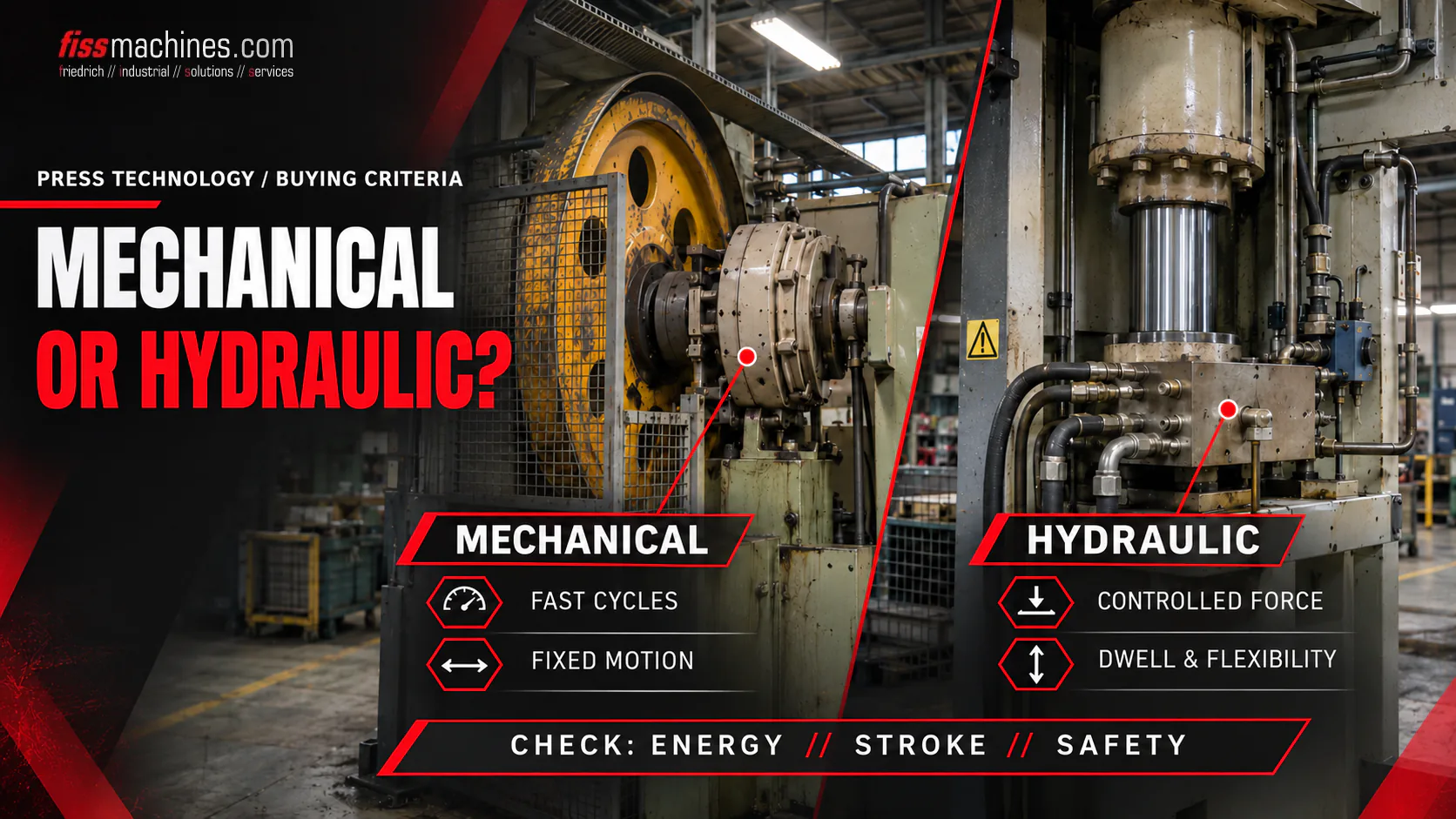
Two presses with the same nominal force can behave completely differently. One delivers full force only just before the bottom of the stroke but runs fast; the other presses with full force anywhere in the stroke and can hold it, but cycles more slowly. The part, the die and the volume decide – not the tonnage plate.
What Is the Difference Between a Mechanical and a Hydraulic Press?
A mechanical press converts the rotation of a motor and flywheel into the up-and-down movement of the slide via a crankshaft, eccentric or linkage. Its slide stroke is fixed by the drive geometry, and its rated force is only available close to bottom dead centre. A hydraulic press moves the slide with hydraulic cylinders; it can deliver its full force at any point in the stroke and hold that force for a defined dwell time.
In the comparison of a mechanical vs hydraulic press, the mechanical machine is usually faster and suits high-volume stamping; the hydraulic machine is more flexible and suits deep drawing, dwell, trimming and try-out. Servo drives blur the line.
Mechanical Press Drives: Crank, Eccentric, Knuckle-Joint and Link
In all mechanical presses, a flywheel stores energy, a clutch couples it to the drive, and the drive geometry turns rotation into slide travel. The drive variant determines the slide motion and where the force is concentrated.
The Classic Stamping Press
Simple, robust and fast. Rated force is reached only shortly above bottom dead centre and drops higher up in the stroke. Typical for blanking, piercing and bending.
High Force at the Bottom
A toggle linkage slows the slide sharply near bottom dead centre. AIDA describes its knuckle drive as designed for coining, cold forging and net-shape forming, and as less suited to progressive and deep-draw work (manufacturer statement).
Slower Through the Working Zone
A multi-bar linkage slows the slide in the forming zone while keeping approach and return fast – an advantage for drawing, impact noise and die load.
Programmable Slide Motion
A servo motor replaces or supplements the flywheel. Schuler states that its servo presses allow operator-programmable stroke heights and motion sequences without mechanical stroke adjustment (manufacturer statement).
Even on a servo-mechanical press, full force remains tied to the drive geometry near the bottom of the stroke. Drive types and frame designs in stock are shown under used mechanical presses.
How a Hydraulic Press Works – Conventional and Servo-Hydraulic
A hydraulic press uses a pump, valves and one or more cylinders to move the slide. Because the force results from oil pressure and piston area, a hydraulic press can deliver its full force at any slide position. Stroke length, speed, pressing force and dwell time can be set independently – a die change does not require a new mechanical stroke setting. FISS lists such machines under used hydraulic presses.
The weak points are speed and energy: large oil volumes must be moved and the system heats up, so a hydraulic press generally runs fewer strokes per minute than a comparable mechanical press, and constant-speed pumps consume power when idling. Servo-hydraulic drives address this with variable-speed pump motors that deliver only the flow the cycle requires; Bosch Rexroth, for example, states that its Sytronix pump drives make press and recycling applications quieter and more energy-efficient (manufacturer statement, 2022).
Mechanical vs Hydraulic Press: The Key Differences
| Criterion | Mechanical Press (Crank / Eccentric) | Hydraulic Press |
|---|---|---|
| Force-stroke characteristic | Rated force only near bottom dead centre; less force higher in the stroke | Full force available over the entire stroke |
| Stroke rate | High; suited to continuous high-volume production | Lower; limited by oil volume, valves and heat |
| Energy source | Flywheel; energy per stroke is limited at low speeds | Pump and cylinder; force is independent of speed |
| Dwell at bottom | Not possible (knuckle-joint: short dwell) | Freely adjustable |
| Overload behaviour | Depends on an overload protection device; without it, frame, crankshaft or die can be damaged | Pressure relief valve limits the force to the set value |
| Stroke and setup | Stroke fixed or mechanically adjustable; shut height must be set precisely | Stroke, speed and force set in the control |
| Maintenance focus | Clutch and brake, bearings, gears, gibs, lubrication | Oil condition, seals, pumps, valves, leaks |
Typical Press Applications: Stamping, Deep Drawing, Trimming, Try-Out
- Stamping, blanking, progressive dies: the force is needed only at the end of the stroke and the stroke rate counts – a mechanical crank or eccentric press is the usual choice.
- Coining and calibrating: very high force at the bottom with a short dwell – a knuckle-joint press.
- Deep drawing: force over a long working stroke and controlled slide speed – a hydraulic press or a link-drive or servo press.
- Trimming castings: moderate stroke rates, varying die heights and frequent die changes – hydraulic trimming presses are common.
- Die try-out and spotting: slow, precise movement with full control – hydraulic try-out and spotting presses.
In foundries, presses are found above all as trimming presses for die castings; how trimming dies and cells work is explained in Trimming in Die Casting, and used machines are listed under trimming presses. For die try-out, FISS lists spotting presses. Forging presses follow their own selection rules, and transfer automation is a separate topic.
Maintenance and Safety of Mechanical and Hydraulic Presses
On a mechanical press, clutch and brake are both wear part and safety function: the stopping time determines the safety distance of light curtains and guards. Bearings, gears, connecting rods and gibs need reliable lubrication. On a hydraulic press, maintenance focuses on oil condition, filters, seals and hoses; internal leakage shows up as a drifting slide or loss of force.
For press safety in Europe, the series ISO 16092 is relevant: Part 2 (ISO 16092-2:2019) covers mechanical presses with part-revolution clutch and mechanical servo presses and replaces EN 692; Part 3 (ISO 16092-3:2017) covers hydraulic presses and replaces EN 693. Older mechanical presses with a full-revolution clutch cannot stop mid-stroke and are therefore particularly critical; in the USA, for example, OSHA does not permit presence-sensing devices as point-of-operation safeguarding on such presses.
Buying a Used Press: What to Check
Start from the part and the die, not the press: required force and where in the stroke it is needed, die size and weight, shut height, stroke rate and automation. Then compare offers.
- Nominal force, rating point and force-stroke diagram (mechanical) or maximum pressure and force (hydraulic)
- Stroke, shut height, slide adjustment, bed and slide area, T-slots and die clamping
- Clutch and brake condition, stopping-time measurement, overload protection device
- Slide parallelism and gib play under load, frame cracks, signs of past overloading
- Hydraulics: leaks, oil analysis, pump noise, slide drift with the pump switched off
- Control, safety devices, documentation, circuit diagrams and spare part availability
- Die cushion, ejectors and interfaces to feeding or handling equipment
Illustrative example: a supplier wants to trim aluminium castings on several dies with different heights. A fast eccentric press would be oversized in stroke rate and inflexible in setup; a used hydraulic press with sufficient daylight and adjustable stroke usually fits better. If the exact machine is not on the market right now, the FISS machine search service can look for it.
The Process Decides the Press Drive
The mechanical press suits fast, repeatable stamping with force needed only at the bottom of the stroke. The hydraulic press suits long working strokes, held force and frequent setup changes. Knuckle-joint, link and servo drives cover the ground in between. For a used press, the condition of clutch and brake or hydraulics and the safety concept matter as much as nominal force.
Questions About Mechanical and Hydraulic Presses
Is a Hydraulic Press Stronger Than a Mechanical Press?
Not necessarily. Both are rated by nominal force, but a mechanical press reaches that force only near bottom dead centre, while a hydraulic press can apply it over the entire stroke. For operations that need force early in the stroke, a hydraulic press of the same rating can therefore do more.
Why Are Mechanical Presses Faster?
The flywheel stores energy that is released in every stroke, and the crank drive moves the slide continuously without reversing large oil volumes. This allows high stroke rates in continuous high-volume stamping.
What Is a Servo Press?
A servo press uses a servo motor to drive the slide, either via a mechanical drive or via a variable-speed hydraulic pump. The slide motion, speed and stroke can be programmed, which combines part of the flexibility of a hydraulic press with the precision of a mechanical drive.
What Should I Check First on a Used Mechanical Press?
Check the clutch and brake, including a stopping-time measurement, and look for signs of overloading such as frame cracks or excessive play in the drive. Also verify that an overload protection device is present and working.
Used Presses from FISS.
FISS lists used mechanical, hydraulic, trimming and spotting presses and helps you match the drive principle to your application.
Sources
ISO 16092-2:2019 – Machine tools safety – Presses – Part 2: Safety requirements for mechanical presses (European adoption EN ISO 16092-2:2020, replaces EN 692); status as listed by SIS Swedish Institute for Standards, accessed 6 November 2026.
ISO 16092-3:2017 – Machine tools safety – Presses – Part 3: Safety requirements for hydraulic presses (DIN EN ISO 16092-3:2019-08, replaces DIN EN 693:2011-11); DIN Media, accessed 6 November 2026.
OSHA: 29 CFR 1910.217 – Mechanical power presses, osha.gov, accessed 6 November 2026.
AIDA: Knuckle Drive – A Press Drive Designed for Coining, Cold Forging, and Net-Shape Forming Operations, aida-global.com, accessed 6 November 2026.
Schuler: Servo presses in monoblock design, schulergroup.com, accessed 6 November 2026.
Bosch Rexroth: press release Sytronix variable-speed pump drives (PI 024/22), 30 May 2022.
T. M. Lavoie: Press ahead – The top 10 reasons hydraulic presses are the way to go, FAB Shop Magazine Direct, 2017.
FISS Machines: categories Mechanical Presses, Hydraulic Presses and Trimming Presses, fiss-machines.com, accessed 6 November 2026.
