




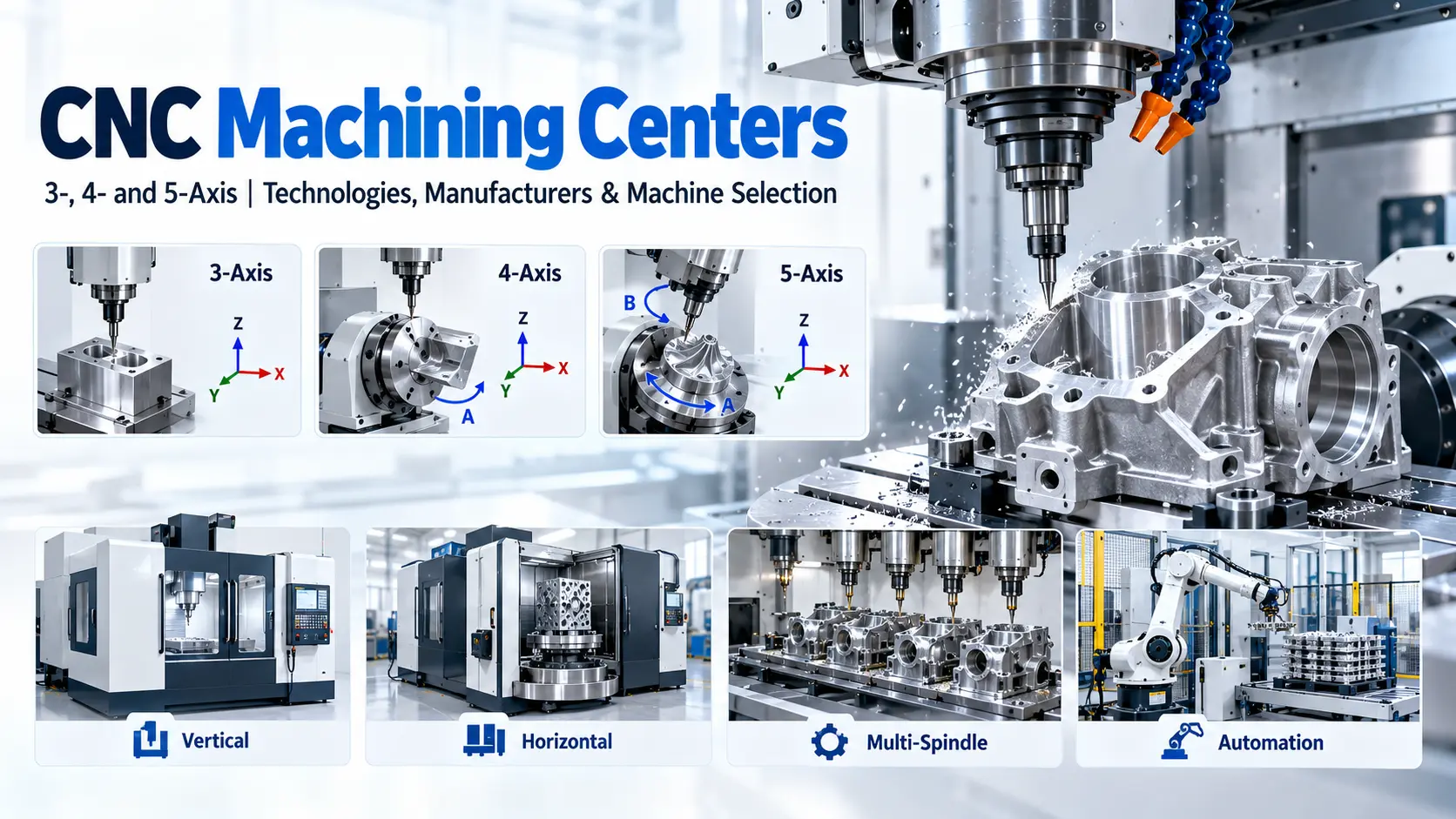
Understanding CNC Machining Centers: Technologies, Manufacturers and Machine Selection
CNC machining centers are among the most important machine tools in industrial metalworking. They are used for milling, drilling, threading and machining precise functional surfaces. Particularly when machining cast components, housings and complex industrial parts, accuracy, productivity and process reliability must work together. But what are the differences between 3-axis, 4-axis and 5-axis machines, vertical and horizontal machining centers, and single-spindle and multi-spindle systems?
Which CNC Machining Center Is Right for Your Application?
The right machining center depends on the workpiece, material, required accuracy, machining operations, production volume and target cycle time. The number of axes and spindles is just as important as workholding, CNC control and automation.
The objective is not to select the machine with the most features, but to choose a machining concept that matches the application and provides an economically efficient production process.
3-Axis, 4-Axis and 5-Axis CNC Machining at a Glance
CNC machining centers differ in the number and arrangement of their controlled axes. These differences influence how a workpiece can be positioned and machined, how many setups are required and which geometries can be produced efficiently.

The most suitable machining concept depends on the workpiece geometry, material, required accuracy, production volume and machining strategy. More axes do not automatically mean greater productivity for every application.
What Is a CNC Machining Center?
A CNC machining center is a computer-controlled machine tool used to manufacture workpieces through material-removal processes. Unlike a basic milling machine, a typical machining center features an automatic tool changer and can perform various machining operations within a CNC program.
These operations include milling, drilling, countersinking, reaming and threading. Depending on the machine configuration, turning and combined mill-turn operations may also be possible.
Modern machining centers can also be combined with pallet changers, robots, automated clamping systems and measuring equipment to create complete manufacturing cells.
Surfaces and Contours
Milling tools machine flat surfaces, pockets, slots and complex three-dimensional contours.
Holes and Precision Fits
Drilling, boring and reaming operations produce holes for fasteners, bearings and other functional features.
Assembly Features
Internal threads are produced using operations such as tapping or thread milling.
Why Many Cast Components Require CNC Machining After Casting
High-pressure die casting, permanent mold casting and low-pressure casting enable the production of complex metal components. Many surfaces are already formed during casting and require little or no additional machining.
However, certain functional areas require tighter dimensional tolerances, more precise geometric relationships or specific surface finishes than can be achieved economically or reliably in the respective casting process.
For this reason, many castings undergo subsequent machining operations. Typical applications include engine housings, transmission housings, hydraulic components, pump housings and other industrial castings.
CNC machining therefore represents an important downstream manufacturing process within industrial production.
3-Axis, 4-Axis or 5-Axis Machining: What Are the Differences?
The number and arrangement of machine axes determine the directions from which a workpiece can be machined. This affects accessibility, the number of setups, CNC programming and the machining strategy.
| Machining Concept | How It Works | Typical Applications |
|---|---|---|
| 3-Axis Machining | Machining takes place using the three linear axes X, Y and Z. | Flat surfaces, pockets, hole patterns and simple to moderately complex milling operations. |
| 4-Axis Machining | An additional rotary axis enables rotation or positioning of the workpiece or tool. | Multi-sided machining of housings and repeatable production components. |
| 5-Axis Positional Machining | In 3+2 machining, additional rotary axes position the workpiece or tool. Machining then takes place with a fixed orientation. | Multi-sided machining, angled holes and complex workpiece geometries. |
| 5-Axis Simultaneous Machining | Three linear axes and two rotary axes can move in coordination during the cutting operation. | Freeform surfaces, complex contours and demanding tool paths. |
A 5-axis machining center can offer significant advantages for complex geometries. However, it is not automatically more economical than a 3-axis or 4-axis machine. For relatively simple components and high production volumes, a specialized multi-spindle or horizontal machining center may be the more suitable solution.
Vertical, Horizontal or Multi-Spindle Machining?
In addition to the number of axes, the overall machine configuration determines how a workpiece can be machined, clamped and automated.
Vertical Machining Centers
Vertical machining centers feature a vertically oriented main spindle. They are frequently used for flexible milling, drilling and threading operations.
Horizontal Machining Centers
The horizontally oriented spindle can support multi-sided machining, chip evacuation and automated pallet systems, depending on the machine design.
Multi-Spindle Machining Centers
Machines with multiple spindles can machine several workpieces in parallel. This can increase output per machining cycle, particularly in series production.
5-Axis Universal Machines
Additional rotary axes improve access to complex workpiece geometries and can reduce the number of required setups.
Mill-Turn Centers
Combined mill-turn machines integrate different machining processes. Depending on the equipment, they enable complete machining of complex components.
Transfer and Manufacturing Cells
Multiple machining stations or machines are connected through automated workpiece handling to create a coordinated production process.
SW, CHIRON, GROB, HELLER, DMG MORI and OKUMA at a Glance
The used CNC machine tool market includes a wide range of manufacturers and machining concepts. Established brands for industrial machining applications include SW Schwäbische Werkzeugmaschinen, CHIRON, GROB, HELLER, DMG MORI and OKUMA.
The following profiles highlight typical technical strengths of selected machine series. They do not replace an assessment of the specific machine, as equipment and machining capabilities vary depending on model, configuration and year of manufacture.
SW Schwäbische Werkzeugmaschinen
SW develops CNC machining centers for highly productive industrial machining operations. The company is particularly known for single-spindle and multi-spindle machines designed for repeatable manufacturing tasks.
Twin-spindle concepts such as the SW BA 622 enable the parallel machining of two workpieces.
Typical focus: Series production and multi-spindle machiningCHIRON
CHIRON offers vertical CNC machining centers, mill-turn solutions and automation concepts. Depending on the machine series, key characteristics include compact design, dynamic machining and high productivity.
Single-spindle and twin-spindle machines are used in applications including automotive and industrial component manufacturing.
Typical focus: Flexible and productive machiningGROB
GROB offers 5-axis universal machining centers designed for complex milling applications.
Machine series such as the G350 and G550 combine a horizontal spindle arrangement with additional rotary axes. This enables multi-sided and 5-axis machining.
Typical focus: 5-axis universal machiningHELLER
HELLER offers a range of horizontal machining centers as well as 5-axis and mill-turn solutions.
The 4-axis H-series, for example, focuses on productive and repeatable series machining. Other machine series provide additional machining capabilities.
Typical focus: Horizontal multi-sided machiningDMG MORI / Mori Seiki
DMG MORI offers a broad range of milling machines, turning machines, 5-axis machining centers and combined manufacturing solutions.
In the used machinery market, buyers may encounter DMG machines, older machines marketed under the Mori Seiki brand and machines carrying the DMG MORI name.
Typical focus: Milling, turning and complete machiningOKUMA
OKUMA manufactures CNC turning machines, milling machines, machining centers and combined mill-turn machines.
The MULTUS series, for example, combines turning and milling operations within one machine concept. Actual capabilities depend on the specific configuration.
Typical focus: CNC turning and combined machiningWhat Role Does Automation Play in CNC Machining Centers?
In addition to actual cutting time, loading, unloading, clamping, tool changes, measuring and workpiece transport influence the overall cycle time.
Automated manufacturing cells therefore aim to make these auxiliary operations more efficient and repeatable. Depending on the system, pallet changers, robots, workpiece storage systems or interconnected machining stations may be used.
A pallet changer, for example, can allow a new workpiece to be prepared while the machine is machining another component. The actual productivity improvement depends on machining time, loading concept and the overall process sequence.
What Is Particularly Important When CNC Machining Cast Components?
Cast components differ from precisely pre-machined semi-finished products. Depending on the casting process, raw dimensions, surfaces, draft angles and machining allowances may vary.
Workholding fixtures must therefore be designed to position the casting securely without causing unacceptable deformation. At the same time, the required positional relationships between functional surfaces must be maintained.
Particularly for housings with bearing bores, sealing surfaces or precise assembly points, a suitable machining sequence is essential.
Securely Position the Raw Casting
Clamping fixtures must match the workpiece geometry and the available reference surfaces.
Remove Material Where Required
The defined machining allowances must be sufficient to produce the required functional geometries.
Verify Machining Results
Measurements are used to verify dimensions, geometric relationships, surfaces and specified tolerances.
Machining operations can also expose previously hidden casting defects. For example, opening internal pores on a sealing surface may affect the functionality of the component.
Casting quality, machining strategy and downstream quality inspections should therefore be coordinated as early as possible.
Which CNC Machine Is Suitable for Which Manufacturing Task?
Selecting a machining center should ideally begin with the workpiece and manufacturing requirements, rather than with a particular machine brand.
In addition to the required machining operations, the number of setups, production volume and required machining accuracy should be taken into account.
| Manufacturing Task | Possible Machine Solution | Key Selection Criteria |
|---|---|---|
| Simple milling and drilling | 3-axis machining center | Working area, spindle, workholding and required accuracy. |
| Multi-sided machining | 4-axis horizontal machining center or 5-axis positional machining center | Accessibility, number of setups and machining sequence. |
| Complex freeform surfaces | 5-axis machining center | Machine kinematics, CNC control, programming and accuracy. |
| High-volume series production | Multi-spindle machining center or automated manufacturing cell | Cycle time, production volume, loading and machine availability. |
| Components requiring turning and milling | Mill-turn center | Workpiece geometry, required operations and workholding concept. |
What Should You Check When Buying a Used CNC Machining Center?
A used CNC machining center can be an economically attractive alternative to purchasing a new machine. However, its technical equipment and actual condition must match the intended application.
Manufacturer, model and year of manufacture should not be the only selection criteria. Spindle condition, guideways, axis drives, CNC control, tool changer and peripheral equipment also influence the machine's future usability.
- Manufacturer, model and year of manufacture
- Machine type and number of axes
- Axis travels and usable working area
- Maximum workpiece dimensions and weight
- Spindle speed, power and torque
- Spindle bearings, operating noise and thermal condition
- Tool interface and tool magazine
- Automatic tool changer and tool-change times
- Axis drives, guideways and ball screws
- Rotary and swivel axes
- CNC control and available software version
- Machine accuracy and available inspection reports
- Clamping fixtures and pallet changers
- Coolant supply and chip evacuation
- Hydraulic, pneumatic and safety systems
- Maintenance history and operating hours
- Technical documentation and spare-parts availability
- Dismantling, transport and installation requirements
Twin-Spindle CNC Machining: The SW BA 622 as an Example
The SW BA 622 from SW Schwäbische Werkzeugmaschinen is an example of a productive series machining concept.
In a documented sales project, FISS arranged the sale of a used twin-spindle 5-axis CNC machining center of this type. The machine was equipped with a Siemens SINUMERIK control, two main spindles and extensive equipment for industrial machining processes.
This machine concept demonstrates how parallel workpiece machining can be combined with multiple machining axes. Whether such a configuration is economical depends primarily on the component, production volume, workholding technology and required cycle time.
More information about the completed project: Successful Sale of an SW BA 622 by FISS .
Buying and Selling Used CNC Machining Centers
FISS supports industrial companies in the international purchase and sale of used machining centers, CNC milling machines, turning centers and complete manufacturing solutions.
Depending on current availability, machines from various manufacturers may be considered, including SW, CHIRON, GROB, HELLER, DMG MORI, Mori Seiki and OKUMA.
Depending on the project, technical assessment, dismantling, transport and reinstallation may also play an important role in the overall machine transaction.
An overview of available machinery can be found in the FISS category Used CNC Machining Centers .
The Right CNC Machine Depends on the Machining Application
Whether a vertical 3-axis machining center, a horizontal 4-axis machine, a 5-axis universal machining center or a multi-spindle production system is the most suitable solution depends on the intended manufacturing process.
Workpiece geometry, material, required accuracy, machine kinematics, workholding and automation must be considered as one complete system.
Manufacturers such as SW, CHIRON, GROB, HELLER, DMG MORI and OKUMA offer different technical concepts. However, when purchasing a used machine, evaluating its specific configuration and actual technical condition remains essential.
Questions About CNC Machining Centers
What Is the Difference Between a CNC Milling Machine and a Machining Center?
A machining center typically combines multiple machining operations with an automatic tool changer. Depending on the configuration, CNC milling machines may be simpler or similarly comprehensive. The terms overlap in practical usage.
When Is a 5-Axis Machining Center Worthwhile?
A 5-axis machine can be particularly useful for complex workpiece geometries, angled machining surfaces or applications requiring access from multiple directions. The key question is whether it can reduce setups, machining time or quality risks.
What Are the Advantages of a Twin-Spindle CNC Machine?
Depending on its design, a twin-spindle machine can machine two workpieces simultaneously. This can increase production output in series manufacturing, provided the component and workholding concept are suitable.
Which Machining Centers Are Suitable for Aluminum Die Castings?
Depending on workpiece size, machining surfaces and production volume, vertical, horizontal, 4-axis, 5-axis and multi-spindle CNC machining centers may be suitable. Selection should always be based on the specific machining requirements.
Which Manufacturers of CNC Machining Centers Are Relevant?
Established manufacturers include SW Schwäbische Werkzeugmaschinen, CHIRON, GROB, HELLER, DMG MORI and OKUMA. The most suitable manufacturer depends on the required machine concept and the intended application.
What Matters Most When Buying a Used CNC Machining Center?
Important factors include spindle condition, axis accuracy, CNC control, tool changer, workholding equipment, maintenance history and compatibility with the planned production process.
Can FISS Search for a Specific CNC Machining Center?
Yes. If a suitable machine is not currently available in the inventory, FISS can conduct a targeted machine search based on manufacturer, model, technical requirements, location and desired delivery timeframe.
FISS Supports the Purchase and Sale of Used CNC Machining Centers.
Whether SW, CHIRON, GROB, HELLER, DMG MORI or OKUMA: The machine concept, technical equipment and condition must match the intended manufacturing application.
Technical Background and Sources
Technical manufacturer information from SW Schwäbische Werkzeugmaschinen, CHIRON, GROB, HELLER, DMG MORI and OKUMA. Additional information: Machine descriptions and project references from FISS Machines.
