




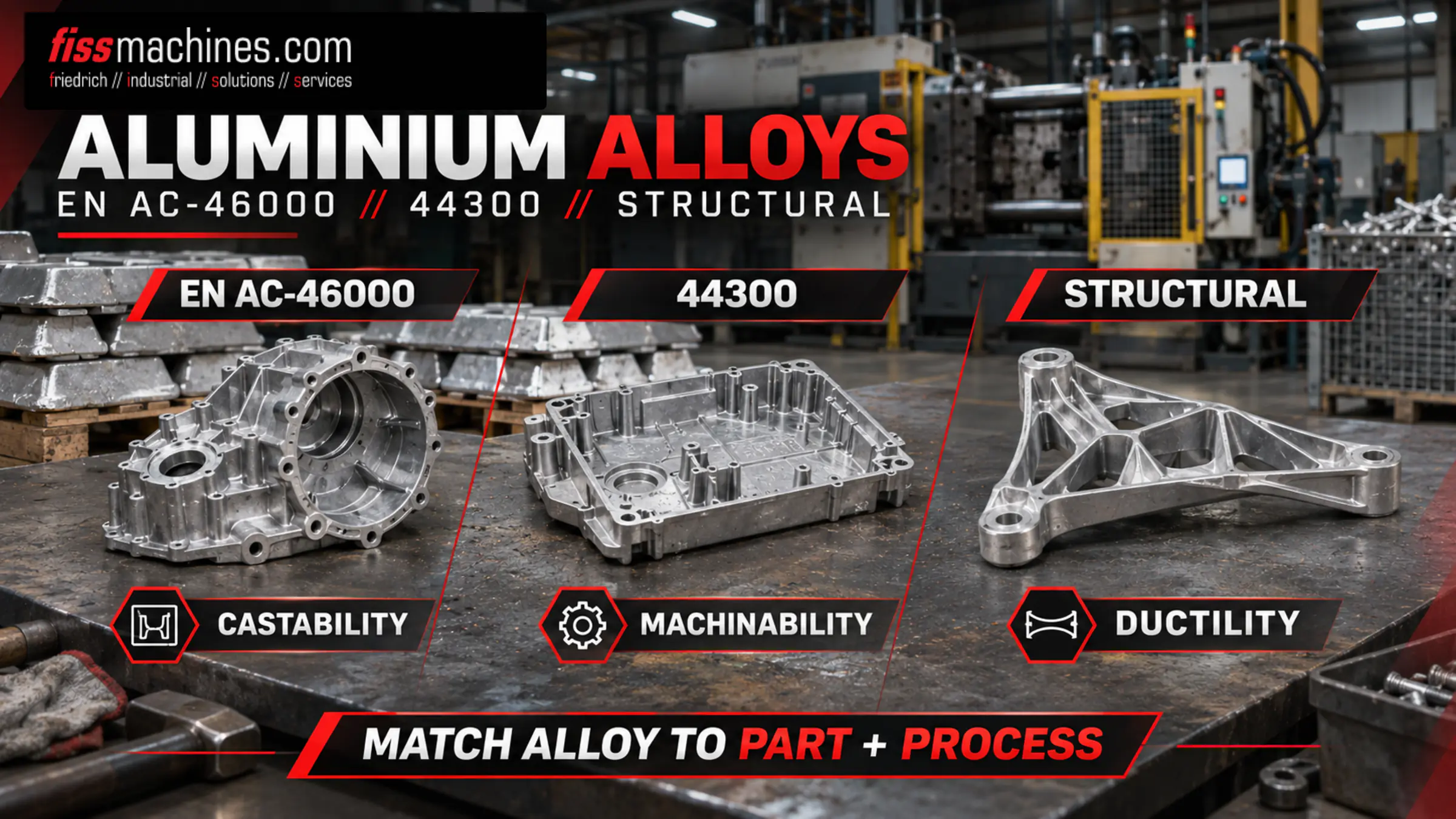
Aluminium Die Casting Alloys: EN AC-46000, 44300 and Structural Alloys Compared
The drawing says “EN AC-46000”, the supplier offers “AlSi9Cu3(Fe)” and the customer asks whether a low-iron alloy would be better for a crash part. Behind these designations lie very different alloys – with consequences for castability, die soldering, ductility, heat treatment and joining.
What Are Aluminium Die Casting Alloys?
Aluminium die casting alloys are casting alloys whose composition is tuned for high pressure die casting (HPDC): mostly aluminium–silicon alloys with good fluidity, some with copper or magnesium, and – for structural parts – low-iron variants with manganese or aluminium–magnesium alloys. In Europe their composition limits are defined in EN 1706.
The designation EN AC-46000 is the numerical form of EN AC-AlSi9Cu3(Fe): an aluminium casting alloy with nominally about 9 % silicon and 3 % copper and a wide iron tolerance.
How to Read EN 1706 Alloy Designations
EN 1706 uses two equivalent designation systems, which refer to EN 1780-1 (numerical) and EN 1780-2 (chemical symbols).
| Element | Example | Meaning |
|---|---|---|
| EN | EN AC-46000 | European standard designation |
| A | EN AC-… | Aluminium |
| C or B | AC / AB | C = casting (EN 1706), B = ingot for remelting (EN 1676) |
| Five digits | 46000 | Numerical alloy code; the first digit names the main alloying element: 2 = copper, 4 = silicon, 5 = magnesium, 7 = zinc |
| Chemical symbols | AlSi9Cu3 | Main elements with their nominal contents in per cent |
| Suffix in brackets | (Fe) | Distinguishes an alloy from a variant of similar nominal composition; here the variant with a higher permitted iron content |
The alloy list in EN 1706 shows the logic: EN AC-21200 is AlCu4MnMg, EN AC-51300 is AlMg5 and EN AC-71100 is AlZn10Si8Mg. Within the silicon group, the second digit separates families – 46000 AlSi9Cu3(Fe) and 46200 AlSi8Cu3 are both AlSiCu alloys. A complete product designation on a drawing also states the casting process and the temper.
Which Edition of EN 1706 Applies?
The current version is EN 1706:2020+A1:2021, published in Germany as DIN EN 1706:2021-10 and in the UK as BS EN 1706:2020+A1:2021. Compared with EN 1706:2010, the 2020 edition added six alloys, deleted two, lowered the maximum lead content to 0.29 % and revised the HPDC mechanical properties of EN AC-43500 and EN AC-46000, among other changes.
The Standard HPDC Alloys: EN AC-46000, 44300, 47100 and 43400
Most die castings in housings, covers and brackets are made from a small group of aluminium–silicon alloys with a comparatively high iron tolerance. Their limits allow production from recycled metal; why this is so is explained in Recycling in the Aluminium Foundry.
AlSi9Cu3(Fe)
The universal HPDC alloy: very good castability and good strength as cast thanks to copper. Copper lowers corrosion resistance; elongation is limited.
AlSi12(Fe)
Near-eutectic alloy with excellent fluidity for thin-walled, pressure-tight parts. Low copper, so better corrosion behaviour than AlSi9Cu3.
AlSi12Cu1(Fe)
Eutectic silicon level with about 1 % copper – a middle way between AlSi12(Fe) and AlSi9Cu3(Fe) in strength and corrosion.
AlSi10Mg(Fe)
Magnesium-containing alloy in the iron-tolerant HPDC version. Magnesium allows age hardening, but the iron content limits ductility.
Structural Alloys: Low Iron, Manganese and Magnesium
Body-in-white parts such as shock towers, longitudinal members or door frames must deform before they crack, and they are often riveted or welded. For these parts, alloy producers have developed low-iron alloys. Two types are established: AlSi10MnMg (EN AC-43500) and AlMg5Si2Mn.
Low-Iron AlSi Alloy
Example Silafont-36 (Rheinfelden Alloys): Si 9.5–11.5 %, Mn 0.5–0.8 %, adjustable Mg 0.1–0.5 %, strontium-modified, iron kept very low. The manufacturer lists tempers F, T4, T5, T6 and T7, with 15–20 % elongation in T7.
Aluminium–Magnesium Alloy
Example Magsimal-59 (Rheinfelden Alloys, numerical designation 51500): designed for the as-cast state F. The manufacturer states 12–18 % elongation at 2–4 mm wall thickness and says no T6 or T7 heat treatment is required.
All figures are manufacturer statements and depend on wall thickness and casting quality. Rheinfelden describes both alloys as weldable and suitable for self-piercing riveting and adhesive bonding. Whether a solution treatment is possible at all depends on the gas content of the casting – see Heat Treatment of Aluminium Die Castings and Mold Filling and Vacuum.
Why Iron Matters: Die Soldering, Ductility and Manganese
In aluminium die casting alloys, iron has two faces. Molten aluminium has a strong affinity for the iron of the steel die; this is the main driver of die soldering, as Kohlhepp et al. (2021) describe. A certain iron content in the alloy reduces this attack. On the other hand, iron forms needle-shaped AlFeSi phases that lower elongation and fatigue strength and act as crack initiators.
Low-iron structural alloys therefore use manganese instead of iron. According to Zovi and Casarotto (Aluminium Rheinfelden, 2007), manganese provides good ejection and reduces die soldering, while forming compact, globular phases instead of needles; raising iron to improve ejection would increase sludge formation. Kohlhepp et al. note that manganese additions of up to about 0.8 % are needed and that the extra phases can themselves reduce ductility. Die-side measures against soldering are covered in Die Casting Die Life.
Aluminium Die Casting Alloys Compared
The table gives qualitative orientation. Exact limits are given in EN 1706 and the supplier’s data sheet.
| Alloy | Iron Level | Heat Treatment | Strengths | Limitations |
|---|---|---|---|---|
| EN AC-46000 AlSi9Cu3(Fe) | High tolerance | Normally F | Castability, strength as cast, recycled content | Corrosion, low elongation |
| EN AC-44300 AlSi12(Fe) | High tolerance | Normally F | Fluidity, thin walls, pressure tightness | Moderate strength |
| EN AC-47100 AlSi12Cu1(Fe) | High tolerance | Normally F | Fluidity with some copper strengthening | Corrosion lower than AlSi12(Fe) |
| EN AC-43400 AlSi10Mg(Fe) | High tolerance | Normally F | Castability, magnesium for ageing | Ductility limited by iron |
| EN AC-43500 AlSi10MnMg | Low, Mn instead of Fe | F to T7 | Ductility, joinability, adjustable properties | Clean melt, vacuum for T6/T7, separate returns |
| AlMg5Si2Mn | Low | Designed for F | Elongation as cast, corrosion | Properties fall with wall thickness; magnesium-rich melt needs careful handling |
Strontium-modified alloys such as AlSi10MnMg pick up more hydrogen, so Zovi and Casarotto recommend efficient melt cleaning, for example impeller degassing – see Aluminium Melt Quality.
How to Choose an Aluminium Die Casting Alloy
Function
Is the part a housing, a pressure-tight component or a crash-relevant structure? Ductility and joining requirements narrow the field fastest.
Properties and Temper
Are the required values reachable as cast, or is heat treatment needed? T6 and T7 require a low-gas process.
Environment
Corrosion exposure and coating decide whether a copper-containing alloy is acceptable.
Castability
Wall thickness, flow length and pressure tightness favour high-silicon alloys.
Supply and Plant
Availability, recycled content, separate furnaces and returns for low-iron alloys, and the cost of vacuum and heat treatment.
A typical, illustrative case: a gearbox cover with ribs and sealing faces, painted, without crash requirements, is usually cast in AlSi9Cu3(Fe) in temper F. A shock tower that must be riveted and absorb energy points to AlSi10MnMg with vacuum and T6 or T7 – or to AlMg5Si2Mn if heat treatment and straightening are to be avoided. The final choice belongs to the part specification and the alloy supplier. Material families are compared in Aluminium, Zinc or Magnesium?
The Alloy Designation Is a Short Specification
An EN 1706 designation already tells engineers much: silicon level, copper or magnesium, and – through the (Fe) suffix – whether the alloy tolerates iron. Iron-tolerant AlSi alloys such as EN AC-46000 and 44300 remain the economical standard for housings. Structural parts need low-iron alloys with manganese or magnesium, a clean melt and often vacuum.
Questions About Aluminium Die Casting Alloys
What Does the (Fe) in AlSi9Cu3(Fe) Mean?
The suffix in brackets distinguishes the alloy from a variant with similar nominal composition. In AlSi9Cu3(Fe), it marks the variant with a higher permitted iron content, which suits high pressure die casting and production from recycled metal. The exact limit is in EN 1706.
Can EN AC-46000 Die Castings Be Heat Treated to T6?
Conventional AlSi9Cu3(Fe) die castings are normally used as cast. Entrapped gas can cause blisters during solution treatment, and the alloy is not designed for high ductility. Stress relieving or ageing at lower temperatures should be clarified with the supplier.
Why Do Structural Alloys Use Manganese Instead of Iron?
Iron reduces die soldering but forms brittle needle-shaped phases. Manganese also helps against soldering and ejection problems, but forms more compact phases, so ductility is retained.
Is EN AC-44300 More Corrosion Resistant Than EN AC-46000?
As a low-copper alloy, AlSi12(Fe) generally behaves better in corrosive environments than copper-containing AlSi9Cu3(Fe). For a specific application, the supplier data and a test under real conditions are decisive.
Cold-Chamber Machines from FISS.
FISS lists used cold-chamber die casting machines and peripheral equipment for aluminium alloys. Contact us to discuss which machine suits your parts and alloy.
Sources
EN 1706:2020 – Aluminium and aluminium alloys – Castings – Chemical composition and mechanical properties, CEN, April 2020 (preview of STN EN 1706:2020: foreword, list of changes, scope, table of contents).
DIN EN 1706:2021-10 (German version EN 1706:2020+A1:2021), table of contents, din.de; BSI Knowledge: BS EN 1706:2020+A1:2021, status current, accessed 19 November 2026.
Rheinfelden Alloys: Silafont-36 [AlSi10MnMg] – Features and Magsimal-59 [AlMg5Si2Mn] – Features, version 2016-01; alloy pages Silafont and Magsimal, rheinfelden-alloys.eu, accessed 19 November 2026 – manufacturer statements.
A. Zovi, F. Casarotto (Aluminium Rheinfelden): Silafont-36, the low iron ductile die casting alloy – development and applications, La Metallurgia Italiana, June 2007, pp. 33–38.
M. Kohlhepp, P. J. Uggowitzer, M. Hummel, H. W. Höppel: Formation of Die Soldering and the Influence of Alloying Elements on the Intermetallic Interface, Materials 14 (2021) 1580.
ISO 3522:2007 – Aluminium and aluminium alloys – Castings – Chemical composition and mechanical properties, fourth edition (preview).
